Acharya Devo Bhava – Understanding Guru-Shishya Parampara

Acharya Devo Bhava
Understanding Guru-Shishya Parampara
The culture of a society depends on the culture of individuals comprising it, as also the relationship they have among themselves. Indian Classical Music in any form must be learnt directly from the Guru. Historically, Samaveda or Samagana were taught by sages. The Gurukula system is aimed to preserve this traditional art form without losing the values. The family tradition of imparting education is also prevalent, and this trait carries forwards our music system to future generation. The students have the advantage of being in the presence of the Guru all the time, along with the freedom on the part of the Guru to teach according to individual talents and capacities. More importantly, through constant observation, a good student could imbibe the central features of the Guru’s music and his personality. The guru serves as a beacon of knowledge and inspiration, imparting not just the technical aspects of music but also the intricacies of Raga (melodic framework), Tala (rhythmic patterns), and the Aesthetic elements that define Indian classical music.
As they say, “With opportunity comes responsibility”; the privilege of being rooted to a musical family embraces positive challenges. As a kid, when I was able to witness the prowess of my grandmother Smt N Lalitha in the divine instrument Veena, the fascination towards the stringed instrument was quite natural. The house was filled only with traditional music, either played by her along with students during teaching sessions or recording tapes of great masters being repeatedly turned on to make me listen to quality music. Like any ordinary kid, my interests were watching cricket matches or cartoon shows after school hours. Despite being able to recognize almost all common Ragas of our music, I was a lazy singer due to lack of interest in practice. Hence my parents & grandparents jointly decided to approach another musician so that I won’t find reasons to skip Vocal classes like I did with my grandmother. Nevertheless, I realized the importance of learning Veena from herself at the tender age itself, beginning right from the basics of Varisais, Alankaras, Geetham, Swarajathi and so on.
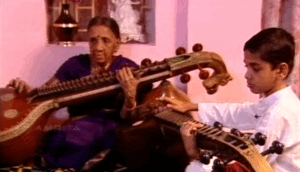
The importance of learning Varnams (both Adi Talam & Ata Talam) is paramount in the primordial stage to any learner and performer alike. Adi Tala Varnams in Ragas Saveri, Kalyani, Abhogi, Mohanam, Suddhadhanyasi, and Ata Tala Varnams in Ragas Bhairavi, Kamboji, Kanada etc would resonate in the entire household on almost all days mostly played with her students who used to be either neighbour kids, music college learners, amateurs or even full-time musicians. This music grooved me to attempt the instrument myself on some random day & after noticing the interest, she started formally to guide me in Veena. During those days (between 2002-2006), I bagged first prize for music competitions organized by various cultural institutions like Sree Swathi Thirunal Sangeetha Sabha, Sree Neelakanta Sivan Sangeetha Sabha & other community organizations like Kerala Brahmana Sabha, Kerala Child Welfare Council to name a few. Interestingly Sree Swathi Thirunal Sangeetha Sabha presented musical books as the award (including certificate) instead of trophies for the winners. As a result, my grandmother taught one or two compositions of Syama Sastri at my behest when I was awarded with that book once. For me, soon enough she decided to purchase one electronic Sruthi box (since the electronic version was a new introduction during those days when old model harmonium box was mostly available) & notated publications of Maharaja Swathi Thirunal & Muthuswami Dikshitar Krithis authored by Prof Kumara Kerala Varma, which included more than 100 Krithis of both composers, to instigate my interest towards the artform. The next mission was to learn around 25-30 compositions of both great composers.
Starting with Maharaja Swathi Thirunal, compositions like Bhogindra Sayinam, Deva Deva Jagadeeswara, Gopalam Seveham, Jaya Jaya Padmanabha Murare, Jaya Jaya Padmanabhanujesa, Jaya Jaya Raghurama, Kripaya Palaya, Pahi Jagajjanani (Hamsanandi & Vachaspati), Pankajaksha Tava Sevam, Sarojanabha, Sathatham Thavaka, & Vande Sada Padmanabham were learnt within a short span of time and practiced every evening after 6 pm. All those compositions were learnt by my grandmother from illustrious Gurus such as Parassala Ponnammal and Vechoor Hariharasubramania Iyer who belonged to a great lineage. As a recipient of Scholarship from the Ministry of Culture, she underwent advance training from legendary Vidwan Padmabhushan KS Narayanaswamy with an aim to master in Veena playing by imbibing the immaculate KSN Bani. To her students, she passed on the Gayaki style (reproducing vocalized dynamics, particularly in rendition of compositions) followed by Vidwan KS Narayanaswamy, giving more importance to nuances and subtleties over rhythm-based acrobatics.
By the mid of 2007, I fortuitously participated for a Carnatic music reality show titled Ragaratnam telecasted by Amrita TV (later emerged as one of the winners in finals) as the youngest participant amongst 3000 candidates. This was a casual & impromptu affair for me with minimal to zero performance experience & knowledge sharing stage alongside senior accompanists (though I used to successfully partake competitions for solo performances). Things became very serious after each round, enabling my learning experience more & more interesting. While rendering Varnams (Kanada & Sankarabharanam), or Pancharatnam (Sadhinchane, Raga Arabhi), musical aspects were taken care by my grandmother on the one hand, whereas rhythmic aspects were taken care by another Vocal Guru Sri Kavalam Sajeev for presenting Thillana or exploring Tisra Gathis on aforesaid Varnams (Kanada & Sankarabharanam) for respective rounds. When I was preoccupied with preparation schedule for different class/categories of performance rounds in the reality show (ranging even other genres like Hindustani, Kathakali), her initial plan intending to teach me Muthuswami Dikshitar compositions didn’t happen as expected. The most hilarious and embarrassing experience in my musical life was encountering the Kacheri round, at a time when I haven’t listened to a full-fledged live concert of any single Vidwan. Nevertheless, everything went well throughout the series with God’s grace & I started to regularly perform live concerts soon.
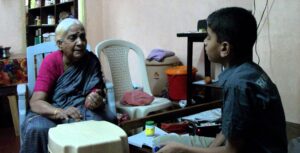
Eventually my grandmother’s guru Vidushi Parassala Ponnammal rose to height of her fame after becoming the first woman performer at the historical Navaratri Mandapam, Thiruvananthapuram. It was a great fortune that she resided in our same Valiyasala Street (Agrahara), Thiruvananthapuram. So, the thought of learning music from her embarked in everyone’s mind within our family. My grandmother advocated for advanced training under the guidance of Ponnammal teacher, so that I could learn more bigwig compositions for the sake of live performances. Learning from a guru’s Guru essentially involves accessing a deeper level of expertise passed down through generations of teaching experience. Musicians like Malladi Brothers (Malladi Suri Babu –> Nedunuri Krishnamurthy –> Sripada Pinakapani), Prince Rama Varma (R Venkataraman –> KS Narayanaswamy), TV Sankaranarayanan (Vembu Iyer –> Madurai Mani Iyer) are few examples. The Carnatic Music system is structured mainly around two aspects, that which is set (Kalpita Sangeetam) and that which is impromptu (Manodharma or Kalpana Sangeetam). The essence of Kalpita Sangitam is the lyric of course with the Raaga and Thaalam mutually complementing it. From Ponnammal teacher, I realized that finding the right balance between both is the secret to success. In this regard, perceiving the magnitude of divagating yet quintessentially Carnatic Ragas were essential. Ragas like Begada, Mukhari, Anandabhairavi, Reethigowla, Atana, Arabhi, Devagandhari, Neelambari, Yadukulakamboji etc possess special character distinguishing them from respective parent Ragas. Hence, they were taught in the best possible manner to explore different shades with much confidence. As a recipient of Junior & Senior Scholarship from Ministry of Culture, Government of India, the learning experience from Ponnammal teacher for more than 13 years redefined my approach towards this artform. Though entertainment quotient is salient, most musicians fail to comprehend the element of Bhakthi and Aesthetics.
The aesthetics can be developed in aspects like Graces (subtle ornamentations of Ragas), Vocal style (based on instruments), Mixing of speeds (in three degrees), practice of enunciating the Sahitya properly etc. The time with Ponnammal teacher (between 2008 to 2020) had been a revelation for me, having gathered deep insights. In this generation of self-promotion and social media, when young as well as matured musicians crave for recognition and awards, Ponnammal teacher is a golden example of humility, despite awards & accolades pouring in from various institutions. Not to forget Padmashri received during 2017 purely out of musical merit without any recommendation. Vidwan Mavelikara Subramaniam has also nurtured me to develop a sense of identity out of his invaluable musical lessons. His stint as a professor at the Swathi Thirunal Music College during 2009 to 2011 warranted high artistic & cultural development to many music students in Thiruvananthapuram & those frequent visits to our home for teaching the magnificent compositions of Sri Lalgudi Jayaraman and GN Balasubramaniam was unforgettable. Realizing her advancing age, my focus shifted towards autonomous learning which she encouraged to do so. Nevertheless, formerly taught compositions were repeatedly practiced on each session with her.
When the pandemic sent shockwaves, musicians were uncertain of performing live again. At this juncture, the only hang out was listening to the music of yesteryear legends & contemporary trendsetters behind closed doors which helped me a lot in reshaping the learning process and eventually developing presentation skills. It’s an undeniable fact that passive listening provides relaxation and mood elevation, while active listening enhances understanding and appreciation of the music’s nuance. My first gen favorites ranged from Sri Madurai Mani Iyer (Master of Sarvalaghu Kalpanaswaras), GN Balasubramaniam (A cult figure) and Semmangudi Srinivasa Iyer (Torchbearer of Tradition). Along with them, Vidwans like Musiri & MDR being regarded as musician’s musician for their extraordinary tonal quality and admirable skills of Vilambitha Sangeetham in neraval singing came out with full emotional content of the Ragas and Krithis that they rendered. Above all, how can we forget the duo united not by blood but by music, famously known as Alathur brothers being the finest singing duo of 20th century. For me, the second gen gems KV Narayanaswamy, DK Jayaraman, S Kalyanaraman and Ramnad Krishnan were the perfect Knights who delivered unique & incomparable bhava-laden music. Amidst all of them, Sri TN Seshagopalan and TV Sankaranarayanan were the giants of third generation known for their briga-laden approach and expertise in high-octave singing. Apart from singing, Sri M Balamuralikrishna’s non-conformism, spirit of experimentation, and boundless creativity always motivate me to excel in the art of composing as well. He left a lasting impression, of how certain micro-modulations of voice can always entertain the discerning audience. Being a male musician, I always have general disinterest listening to female artists (mostly singing at G sharp & above) due to pitch constraints. Only exception being the female trio comprising DK Pattammal, MS Subbulakshmi and ML Vasanthakumari who were well known for their technical expertise as well as profound & unwavering devotion to the artform. In such a way, these aforesaid legends are always a perennial source of inspiration.
Post 2020, Carnatic music saw a radical shift towards online platforms for concerts and learning, with artists adapting to digital formats and audiences adapting to online performances. Even today, long after pandemic restrictions have eased and live performances have resumed, some of these changes remain. For a traditional artform like Carnatic music, live concerts foster a sense of community, as you share the experience with other music lovers. An immersive experience surrounded by the music, the musicians, and the audience, creates a vibrant and engaging atmosphere which cannot be experienced virtually. A short attention span that is typical of today’s generation may have an adverse effect on the effectiveness of online teaching as well (especially instrumental music like Veena). Only time will tell whether such advancements in traditional artforms are reliable & can sustain for long-term. In 2025, looking back on 20 years of learning experience with my Gurus, I feel a deep sense of contentment in my musical career.
Teachers have a long-lasting impact on the lives of their students. I cherish countless captivating memories on and off-stage, thanks to all my Gurus. While their physical presence may be gone, the impact and memories of loved ones remain, and their spirit continues to live on in our hearts and minds. In this era of rapid transformation with independent exploration and discovery, fostering autonomy and critical thinking one may question the need for guided learning. But it must be realized that Carnatic music learners should acquire a comprehensive understanding of the subject with clear learning objectives to excel as a good performer. Great Teachers make for Great Students; and inevitably Gurus like N Lalitha (recipient of Akashavani Gold Medal from President of India) and Parassala Ponnammal (Padmashri and Kendra Sangeet Natak Akademi Awardee) are a testament to their passion for bestowing pristine & traditional music to innumerable learners.