“The Maharaja & The Mahadeva” – A tale of H.H. Swathi Thirunal’s tryst with the divine
Besides Ishtadevata Sree Padmanabha Swami (as well as other Avatars of Lord Vishnu) upon whom Maharaja Swathi Thirunal has composed maximum number of Krithis, the poetic genius was much evident in his compositions extolling other deities as well. When Muthuswami Dikshitar’s Sahitya of the songs in Sanskrit reflected a profound knowledge of the Mantra and Jyotisha Sastras, Swathi Thirunal’s artistic virtuosity can be regarded as simplified extension of Dikshitar. Unlike Dikshitar who focused on Single Charanam, Maharaja’s compositions made up 5 to even 15 of them characterized by emotional depth which can be attributed only to the royal composer. For instance, compositions such as Seve Sri Padmanabham (Raga Mohanam), Navaratri Krithis Devi Jagajjanani & Pahimam Sri Vageeswari (Raga Sankarabharanam & Kalyani), Paramabhadrakara (Raga Dwijavanthi) have very detailed Charanam. Often, we skip more expressive & meaningful ones out of them by selecting only the particular Charanam taught to us or self-learnt. Not forgetting about 25 Varnams (both Sringara & Stava Varnams), and compositions like Kamalajasya (Dasavathara Ragamalika), Pannagendra Sayana (Ashta Ragamalika), Bhavayami Raghuramam & Yojaya Padanalinena (Sapta Ragamalika) featuring detailed passages.
The idea of presenting a thematic series of Swathi’s compositions on Lord Shiva randomly came into my mind when Sree Swathi Thirunal College of Music, Thiruvananthapuram had invited me during 2023, for a performance on Semmangudi Srinivasa Iyer’s Birth Anniversary. Meanwhile, I haven’t learnt any compositions apart from the frequently rendered Parvathi Nayaka, Samodam Paripalaya, Sankara Sreegiri and Jaya Jaya Padmanabhanujesa. However, I decided to take the plunge and explore maximum compositions glorifying Lord Shiva as far as possible. After a comprehensive analysis, 24 such compositions were found. A solitary 3-hour concert won’t be sufficient to present all of them. It was made certain, to be exhibited as a 3-concert series featuring all such compositions commencing from this concert. The initial event titled “Samagana Samrajyam” began with the “Palayamam Deva Parvathi Jaane” (Poornachandrika Pada Varnam attributed to Sreekanteswaram Mahadeva Temple). Maharaja Swathi Thirunal had composed 2 krithis offering obeisance to the Lord of Suchindram. The Thanumalayan temple is known for its quality of workmanship in stone. There are four musical pillars carved out of a single stone, standing at 18 feet (5.5 m) height. They are in the Alankara Mandapam area and emit the sounds of various musical notes when struck. There are an additional 1035 pillars with carvings in the area known as the dancing hall. Vande Maheswaram in Arabhi Raga is an incredible krithi with scintillating Chittaswaram like garland of flowers and Madhyamakala Charanam.
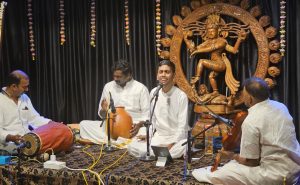
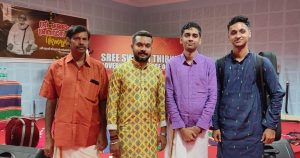
Performing with Sri Trivandrum N Sampath (Violin), Nanjil Arul (Mridangam) and Trivandrum Rajesh (Ghatam) for the 2nd series “Sangeetha Rajarajam”
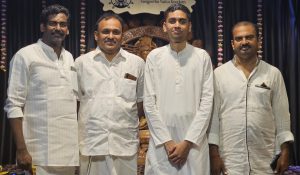
During this concert, I was able to present Nrithyathi Nrithyathi (Raga Sankarabharanam), an amazing vibrant item frequently displayed by Bharatanatyam dancers. Thanks to an amazing version of Prince Rama Varma, which I could find online & comprehend. Most of us would have listened to P Leela rendering this song for an old movie titled Sreedevi released during 1977. Since Sankarabharanam, a Suddha Madhyama Raga was presented as the sub-main piece for the concert, I thought of rendering Samodam Paripalaya in Raga Ramapriya which is a Prathi Madhyama Raga giving good contrast. My Guru Parassala Ponnammal teacher has rendered this composition at numerous venues, and I had the fortune of learning at my initial days with her. Sadly, many a time Vidwans repeatedly sing the incomplete phrase Padmanabha Sahodari instead of “Padmanabha Sahodari Nayaka” after completing each set of Neraval & Swaras. Instead, selecting another Charanam beginning “Pada Nata Bhavabhayahara” by doing Manodharma at “Vedanthagama Vedya Padambuja Vasavadi Suraanatha Sundara” (meaning Lord Shiva is understood and revered through both the Vedas and Agamas. Indra and other celestials genuflect at the lotus feet of handsome Lord) would make difference. Padmanabha Sahodari Nayaka requires a full round of Tala. On the other hand, every pause after a relatively shorter phrase Vedanthagama Vedya (3/4th of a full round Tala) on completion of each Neraval & Swara, gives space for a small halt upon single breath and reflects meaningful Sahitya. The concert also featured compositions Jaya Jaya Padmanabhanujesa (Manirang), Mamava Jagadeeswara (Saraswatimanohari) and Jagadeesha Panchashara Soodana (Nadanamakriya). Surprisingly, after congratulating all 4 of us on stage, Ghatam Vidwan Sri Perukavu Sudheer requested me to further render the renowned Rageshree Thillana (composed by legendary musician Sri Lalgudi Jayaraman) cherished by him. Though Nadanamakriya was supposed to be the ending item, it was an interesting Rageshree ending with great pleasure.
The 2nd series titled “Sangeetha Rajarajam” was held on 29th November 2023 during the occasion of 99th birth anniversary of my Guru, under the auspices of Lalithambika Sangeetha Natya Sabha, a cultural organization established by Sri Unnikrishnan for the promotion of music & dance exclusively beneficial to learners. Apart from Kshetra krithis, Maharaja Swathi Thirunal has also composed generic songs on Lord Shiva. Parvathi Nayaki (Bowli), one among them was selected as the commencing piece. Sreekanteswaram Mahadeva Temple holds significance since the days of old Travancore. The entire stretch from Padmanabhaswamy temple to the area including where the Sreekanteshwaram temple used to be called Onapadanilam. It was here that the kalari veterans used to stage their performances during the Padmanabhaswamy temple festival when the ‘Arattu’ procession would be held. The old Sreekanteshwaram is believed to have been established centuries ago and the new one emerged, when an elderly woman prayed to Shiva as she was unable to visit the temple regularly.
The legend goes that her prayer was answered, and an idol appeared where she resided (Stree Kanda Eeshwaran, meaning the shrine of the God who was seen by a woman). Later, the entire area came to be known after the temple. Four compositions, namely Palayamam Deva Parvathi Jaane (Poornachandrika Pada Varnam), Paramanada Natana (Kedaram), Panchabana Tanuhara (Poorvikalyani) and Palayamamayi Bho (Khamas) are associated with this temple. Out of them, Kedaram & Poorvikalyani were rendered respectively. Another significant temple Vaikom Mahadeva Kshetram holds high significance, where legend has it that Vyaghrapada Maharshi had a profound encounter with Lord Shiva here, leading to the apt naming of Vyaghrapadapuram. With the diffusion of Tamil, the term “Vyaghra” underwent a transformation into Vaikom. The temple has been renovated and expanded several times over the centuries. The current structure dates to the 16th century and was built by Travancore kingdom. The temple is a fine example of Kerala temple architecture and is a popular pilgrimage destination for Hindus from all over the world. Maharaja addresses the Lord as Pahi Tarakshupuralaya (Lord who abides in Tarakshupura, i.e. Vyaghrapadapuram or Vaikom) in two of his compositions set to Ragas Anandabhairavi & Jaganmohini respectively. Anandabhairavi was selected for the day. Unlike Trinity of Carnatic music, who had widely composed songs while travelling to temple destinations, Maharaja was not able to make travel due to administrative reasons. Nevertheless, it’s an undeniable wonder that the composition like Kripakataksham (Mohanam), Vishweshwar Darshan Kar Sindhubhairavi were created by the royal composer without his physical presence at Thiruvaiyaaru or Kashi. With mere mind travelling it’s unimaginable that how the composer has adorned beauty of the lyrics by depicting architectural information, historical events, traditions & festivals related to such temples. Kripakataksham in Raga Mohanam (attributed to Panchanadeeswarar of Thiruvaiyaaru) entirely riveted by its amazing Madhyamakala Sahitya in the Charanam, was sung as the sub-main item.
In addition to Vande Maheswaram, which was rendered in the first series, Kalaye Parvathinatham is also associated with Suchindram Thanumalayan Temple. Sri Syama Sastri’s composition Ninnuvinaga (Poorvikalyani) is set to Viloma Chapu, by altering the sequence of Mathra in Misra Chapu, thereby transforming into its reverse. Likewise, Swathi Thirunal’s Kalaye Parvathinatham also follow the same pattern of Viloma Chapu in Pallavi & Anupallavi. Though I couldn’t learn this composition directly from my Guru, recordings of her rendition in addition to that of Sri Palai CK Ramachandran (both belonging to the lineage of Sri Semmangudi Srinivasa Iyer) were of great help to me. This composition was rendered as the main item for the day. Followingly Hindustani Bhajans Seesa Ganga (Dhanasree) and Sankara Sreegiri (Hamsanandi) also formed final part of this concert. The title Sangeetha Rajarajam was deliberated by contemplating Lord Shiva as the master for musical king Maharaja Swathi Thirunal.
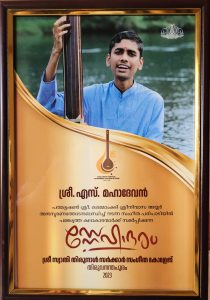
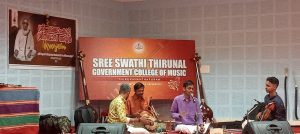
Honor from Sree Swathi Thirunal Govt. College of Music, Thiruvananthapuram and presentation of music concert on the occasion of Semmangudi Srinivasa Iyer Remembrance day (1st series Sangeetha Rajarajam). With Sri Adarsh Ajayakumar (Violin), KV Sachith (Mridangam) and Anchal Krishna Iyer (Ghatam)
Records reflect the 2 compositions Paramabhadrakara (Dwijavanthi) and Bhagavan Samayoyam (Asaveri) as Swathi Thirunal krithis. At that point, sadly no recordings of these 2 compositions were available for me. Also, I didn’t possess the notated publication of Vidwan TK Govinda Rao which included these 2 krithis. Hence, these compositions were set to tune by myself (in the original Ragas mentioned in the available publications) for presenting them in the 3rd and culminating series. Paramabhadrakara Panchanadeesha, like the Mohanam song Kripakataksham is again another dedication to Panchanadeeswarar of Thiruvaiyaaru. As mentioned right from the beginning about the vastness in Sahitya, this Krithi has 5 detailed Charanam with intense overflow of Bhakti. Hence the ending stanzas of Charanam were set as Madhyamakala Sahitya. Same holds true with Bhagavan Samayoyam, the only difference being three Charanam instead of five. The final series “Shankara Rajadhani” was organized by University of Kerala (Department of Music), Thiruvananthapuram. I was able to present yet another magnificent composition Shambho Sathatham (originally sung in Raga Karnataka Kapi) in a rather different version of Varamu Raga, set to tune by Vidwan TV Gopalakrishnan. Thanks to the amazing rendition of Vidushi Amrutha Venkatesh, with a golden touch. Adri Suthavara, an amazing composition in Raga Kalyani was elaborated as the main piece. This composition is well known to the aficionados who would have watched Gaanam Malayalam movie (jointly sung by M Balamuralikrishna & KJ Yesudas). This concert featured the Jaganmohini Raga Pahi Tarakshupuralaya as the invocatory piece praising Lord Vaikathappan and included Palayamamayi Bho (Khamas) praising Lord Sreekanteswara. Sri Tyagaraja, Dikshitar and Maharaja Swathi Thirunal, have all composed lyrics for western melodies. Hara Svedam Kuru Modam by Maharaja is one among them identical to that of Gurumurthe Bahukeerthe composed by Sri Muthuswami Dikshitar. For a receptive audience, such compositions are always thrillful. Again, by virtue of Prince Rama Varma, (descendant of Maharaja Swathi Thirunal himself) we are fortunate to listen and propagate such compositions. Last but not least, how to forget the Hindustani magnum opus “Visweswar Darshan Kar Chal Man Tum Kasi”?? With mere mind travelling, Maharaja undertakes a pilgrimage towards Kasi to have the vision of Lord Visweswara. It’s unfair from musicians’ end, to restrict the krithi only to its third & final Charanam “Padmanabha Kamalanayana Trinayana Shambho Mahesha” because the other two of them reflects much deeper insights highlighting the Ganges River flowing through the city of Kashi like pure milk. In the first Charanam, the composer highlights about Ghats on the banks of river where host of sages reside. (Varanasi, also known as Kashi or Banaras, is famous for its ghats, which are riverfront steps leading down to the Ganges River. There are 84 ghats in total (Dashashwamedh Ghat known for its evening Ganga Aarti ceremony, is considered the heart of the ghats and Manikarnika Ghat is one of the holiest cremation grounds among the sacred riverfronts as well as a Shakti Peetha). The 2nd Charanam points out that, Lord smears his form with holy ash and holds trident in his hands. He is adorned with serpent around his neck.
Resembling the Lord himself, we can find Sadhus with matted dreadlocks fully clad in ashes, holding Serpents. Finally, the composer addresses to worship both the lotus-eyed Lord Padmanabha and the three-eyed Maheswara to be immortal. In general, though the 3rd Charanam alone is sung in Raga Sindhubhairavi, I was able to learn another amazing version embedded in Ragas Pahadi & Kosalam for the first 2 Charanam followed by which final one in Sindhubhairavi is rendered. Later came to know that these were set to tune by Vidwan Nagai Muralidharan & Sanjay Subrahmanyan in respective Ragas. Post completion of this song as a final piece of this entire series along with Bhujagashayino Nama Mangalam, I felt a deep sense of inner contentment and satisfaction. Thanks to almighty, my gurus, organizers and dear accompanists without whom this couldn’t have been possible. Special thanks to my mother for prefixing befitting title for each concert of this series by portraying the deep linkage between Maharaja and the Lord.
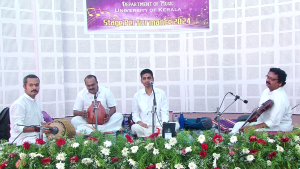
The final series “Shankara Rajadhani” held at University of Kerala (Dept. of Music), Thiruvananthapuram. With Sri Thiruvizha Viju S Anand (Violin), KV Sachith (Mridangam) and Kurichithanam Ananthakrishnan (Ghatam)
Throughout my musical career, I consider it to be an amazing learning and performance experience, offering a befitting tribute to one of the most respected composers in Carnatic music world. Sadly, lot of controversies revolve primarily around the authorship of his musical compositions. Indeed, Thanjavur Quartet were patronised by Maharaja Swathi Thirunal and Vadivelu was for sure recognized as a great asset to his court. Lyrically and musically one can find lot of similarities in Maharaja’s compositions with that of Muthuswami Dikshitar due to the fact that Thanjavur Quartet had learnt various nuances from Dikshitar himself. Of course, lot of musical exchanges would have happened between them; but it’s unfair to underestimate Maharaja by addressing him as a passive onlooker, who made use of court musicians. Leaving out all the rest, let the compositions soaked in Bhakthi capture the hearts and minds of listeners. Only a musically enlighted soul, adept in Sanskrit, Malayalam, Kannada, Tamil, Hindustani, Telugu, Marathi, Tamil, Oriya, Bengali, English and Persian could compose over 400 classical compositions in both Carnatic and Hindustani style. The well-known group krithis are:
- Navaratri Krithis (especially sung as the principal song, on each day of the nine-day festival at Trivandrum Navaratri Mandapam codified by Maharaja)
- Navavidha Bhakthi Krithis (Also known as Navaratnamalika addressing Lord Padmanabha through 9 forms of devotion)
- Utsava Prabandham (Set of 12 compositions, with Sanskrit Shlokas describing each Vahana on 10-day festival during the months of Alpasi and Panguni)
- Jnana Vairagya Krithis (collection of Sanskrit compositions, primarily in the form of devotional songs, that explore themes of knowledge (Jnana) and detachment (Vairagya) from worldly affairs)
Also, we can find Ghanaraga Krithis, Kshetra based & Generic krithis on various deities like Shiva, Rama, Krishna, Narasimha, Devi, Subrahmanya, Ganesha and even Anjaneya. Apart from krithis, various forms of compositions include Varnams (Sringara Padavarna/Tanavarna/Stavavarna), Swarajathis, Padams & Javalis (Sanskrit, Telugu, Kannada & Manipravala), Hindustani Bhajans and Thillana. The other literary works of Maharajah Swathi Thirunal are Bhakti Manjari’, Syanandurapuravarnana Prabandham, Padmanabhasatakam, Muhanaprasa Antyaprasa Vyavastha, Ajamila, Kuchela Upakhyanas.
In addition to his love for Indian classical music, as an incredibly hardworking and supremely committed monarch, he has established codified laws, courts of justice, introduced English education, constructed observatory, installed first Government printing press, established first manuscripts library and took many more initiatives to modernize Travancore state within a short span of 33 years.
May the musical glory of the divine composer enlighten us to take forward his rich & profound legacy. His compositions stand as a true testament to devotion, indicating his belief that all deities are different manifestations of the divine form of Lord Padmanabha.